Collection: Artist Category > The "KA" column (Rosanjin Kitaoji, etc.) > Shoji Kamoda
Born in Kishiwada, Osaka Prefecture in 1933, Shoji Kamoda studied ceramics at Kyoto City University of Arts, where he was taught by masters such as Kenkichi Tomimoto and Yuzo Kondo. After graduating, he helped set up a kiln in Hitachi, Ibaraki Prefecture, before moving to Mashiko and becoming independent, where he developed his own unique ceramic practice.
He was invited to exhibit in Japan and abroad from the 1960s to the 1970s, and won the Japan Ceramic Society Award and the Takamura Kotaro Award in 1967. Furthermore, he was awarded the New Artist Award from the Art Encouragement Prize of the Japan Art Encouragement Prize in 1974, and his innovative forms attracted widespread attention.
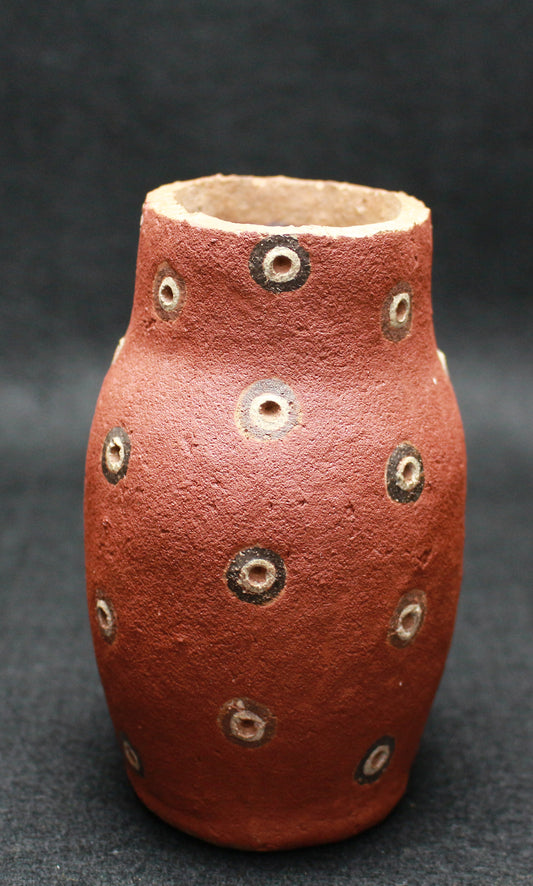
Kamoda's work is characterized by the fact that it transcends the simplicity of traditional Mashiko ware and pioneers new forms of expression that make use of the texture of the clay itself. Focusing on stoneware, he incorporates curved carvings and painted ceramics, and his forms, which do not rely on glazes but instead showcase the clay's surface, have a strong presence. In particular, the unique texture created by firing in a semi-downward flame square kiln has brought a new trend to Mashiko and has influenced many artists.
Although he passed away at the age of just 49, the freedom of expression and experimental spirit he displayed during his short life made him a legendary figure in the field of contemporary ceramics. Kamoda Shoji's works continue to captivate viewers, conveying the strength of clay and the beauty of its form.