


Product number: SKU:26044
26044 Living National Treasure Fukushima Zenzo Nakano Moon White Porcelain Sake Cup FUKUSHIMA Zenzou
26044 Living National Treasure Fukushima Zenzo Nakano Moon White Porcelain Sake Cup FUKUSHIMA Zenzou
Sold out


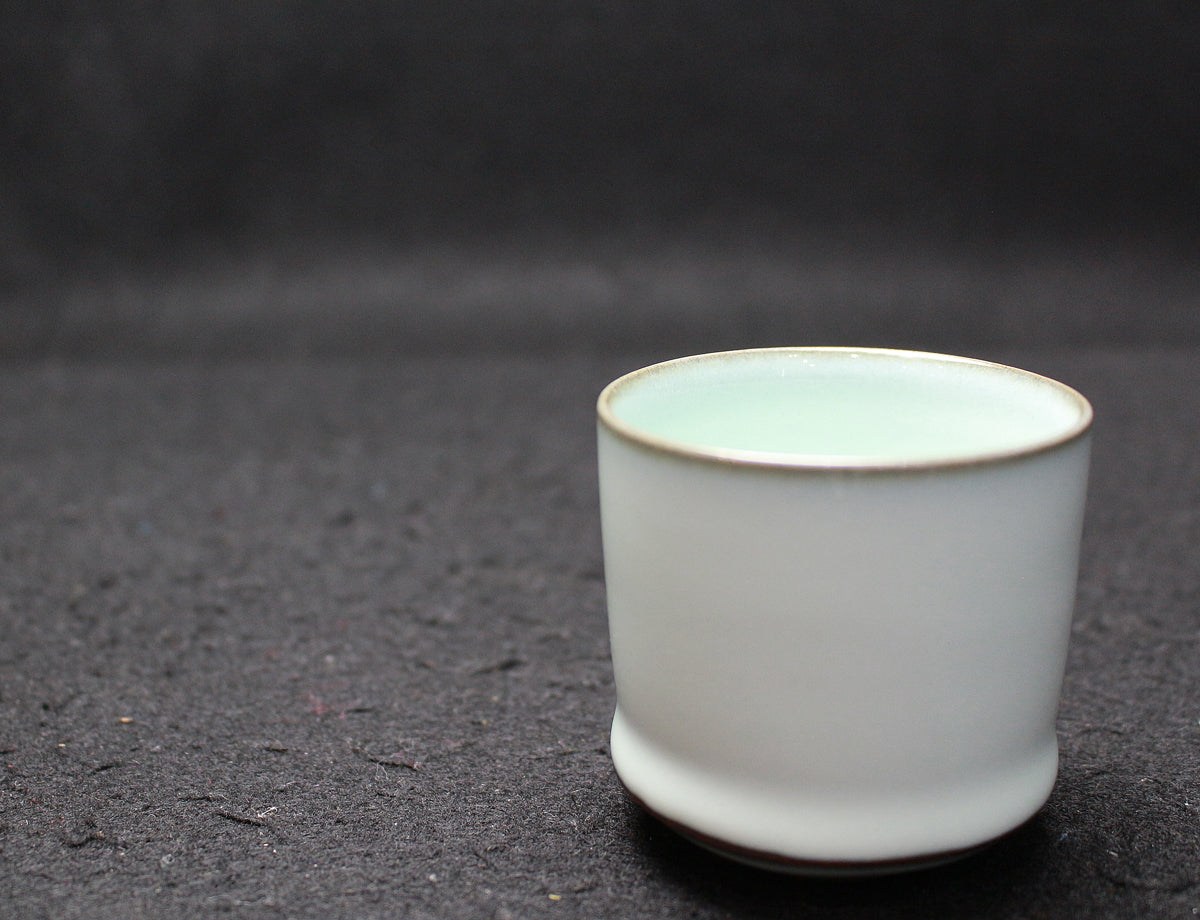


Diameter 6.3cm
The texture of Fukushima Zenzo's Nakanotsuki Hakuji porcelain reminded me of the midnight sun of a Nordic sky that seems to be getting dark but never does. It's not an early night, but the color of the sky at midnight. When viewed in a slightly darker place, it also resembled the color of the cold winter clouds in a Swedish seaside town. It seems bright but isn't bright, seems dark but isn't dark, looks cold but is soft and warm. It's a deep, mysterious color.
Nakano Tsukihaku porcelain originated from a desire for Fukushima celadon. The clay from Koishiwara contains iron and has coarse grains. If the clay used for porcelain like Arita is like drawing paper, then Koishiwara's clay is like cardboard. "Even if you apply a light-colored glaze, it doesn't come out beautifully. It can't compete with white clay. That's why you try to apply iron to create a deep color."
In China, there is a glaze called "Geppei glaze," and he had seen fragments of it in Xi'an. At the time, he thought that Gepei glaze might work, rather than celadon. Inspired by the fact that soybean ash was used in China, he thought, "Let's try using Koishiwara straw ash." This "creates what is called straw white, softening the black parts and creating a milky opaque color. That was the beginning of Gepei porcelain." Even though it is the same straw, rice husk ash produces a blue color. So, "I thought that if I used Koishiwara feldspar, which contains iron, the blue color might come out." From there, it was a process of repeated trial and error. "It doesn't come out suddenly. There is something you are aiming for, and it comes out as you keep trying desperately."