


Product number: SKU:26013
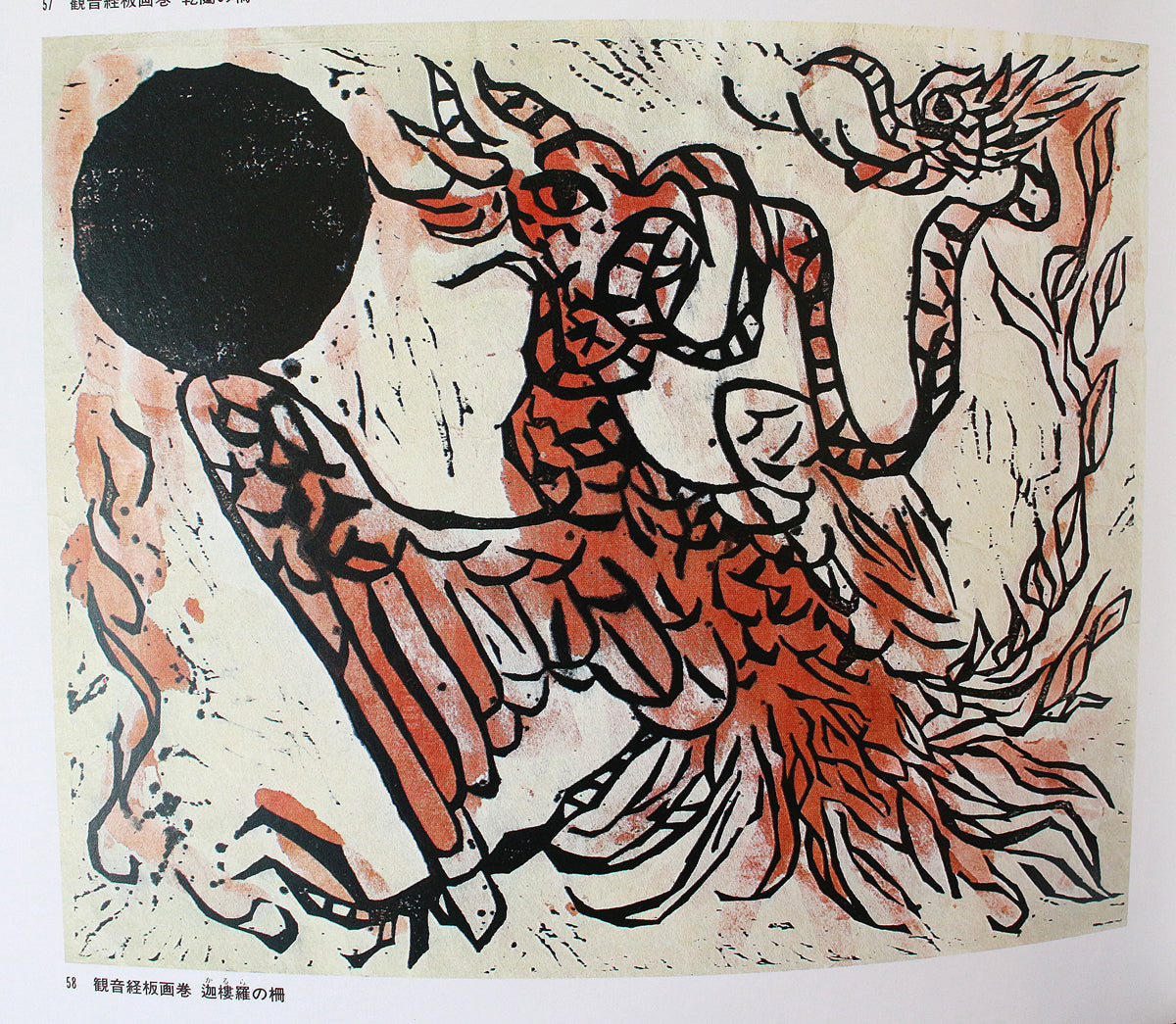
26013 Shiko Munakata, Kannon Sutra Woodblock Scroll "Karura no Ken" (Shiko Munakata Woodblock Prints Complete Set, p. 84, 1963, Shiko Munakata Appraisal Registration Committee)
26013 Shiko Munakata, Kannon Sutra Woodblock Scroll "Karura no Ken" (Shiko Munakata Woodblock Prints Complete Set, p. 84, 1963, Shiko Munakata Appraisal Registration Committee)
Price:ASK
Regular price
Sale price
¥0
Unit price
per
Couldn't load pickup availability




Width 52.0cm
(Height 73.0cm, width 63.0cm including frame)
Shiko Munakata (1903-1975) was a printmaker from Aomori Prefecture. He originally aspired to be an oil painter, but was so impressed by the prints of Sumio Kawakami that he decided to pursue a career as a printmaker. His work was discovered by leaders of the Mingei movement, such as Muneyoshi Yanagi, Kanjiro Kawai, and Shoji Hamada, and his interactions with them had a major influence on his subsequent work.
Munakata refers to his prints as "woodblock prints" rather than "prints." This reflects his philosophy of valuing the inherent qualities of the wood and the soul of the tree, and listening to the voice of the wood. He also gives most of his works the title "Fence of XX," which reflects the spirit of "kairei," the practice of offering talismans during the Shikoku pilgrimage, and the idea of putting a wish into each piece.
About the Kannon Sutra Woodblock Scroll
Shiko Munakata's "Kannon Sutra Wooden Painting Scroll" is one of his most well-known series. In addition to the "Karura Fence," this series also includes several other "fences," such as the "Kannon Sutra Mandala Main Fence" owned by the Japan Folk Crafts Museum, and the "Kannon Sutra Wooden Painting Scroll Upai Fence," "Kannon Sutra Wooden Painting Scroll Brahmin Fence," and "Kannon Sutra Wooden Painting Scroll Gandharu Fence," all of which are on display at the Minamiuonuma Imaizumi Memorial Museum Art Station. The "Asura Fence" is also considered to be part of the "Kannon Sutra Wooden Painting Fence."
The appeal of Shiko Munakata's works
Munakata Shiko's works are known as "Munakata of the World" for their dynamic beauty and overflowing vitality. His works are bold and powerful, creating an original world that anyone can recognize as Munakata's work. In addition to black and white "woodblock prints," he also uses a technique called "reverse coloring," which involves coloring the back of the paper, to create vibrant colors in his works.
About Garuda
Garuda is a Buddhist guardian deity that originated from Garuda, a sacred bird that appears in Indian mythology. It is said that Garuda exterminates poisonous snakes (dragons) by eating them, and in Buddhism, he is worshipped as a being that devours evil dragons, which are symbols of worldly desires. For this reason, he is said to have the power to ward off rare diseases, prolong life, and bring about rain and stop the rain.
Garuda is often depicted as a half-bird man with a bird's face and a human body, and some depict him with wings or stepping on snakes. He is also sometimes depicted engulfed in flames, and the flames on the halo of the Acala statue are called "Garuda flames" and represent the flames breathed by Garuda.
There are many bird-headed Garuda statues remaining in Japan, and the one at Kofuku-ji Temple is particularly famous. Garuda statues were also made as gigaku masks and gyodo masks.