


Product number: SKU:26224
26224 Osamu Suzuki
26224 Osamu Suzuki
Regular price
¥100,000
Regular price
Sale price
¥100,000
Unit price
per
Tax included.
Shipping calculated at checkout.
Couldn't load pickup availability


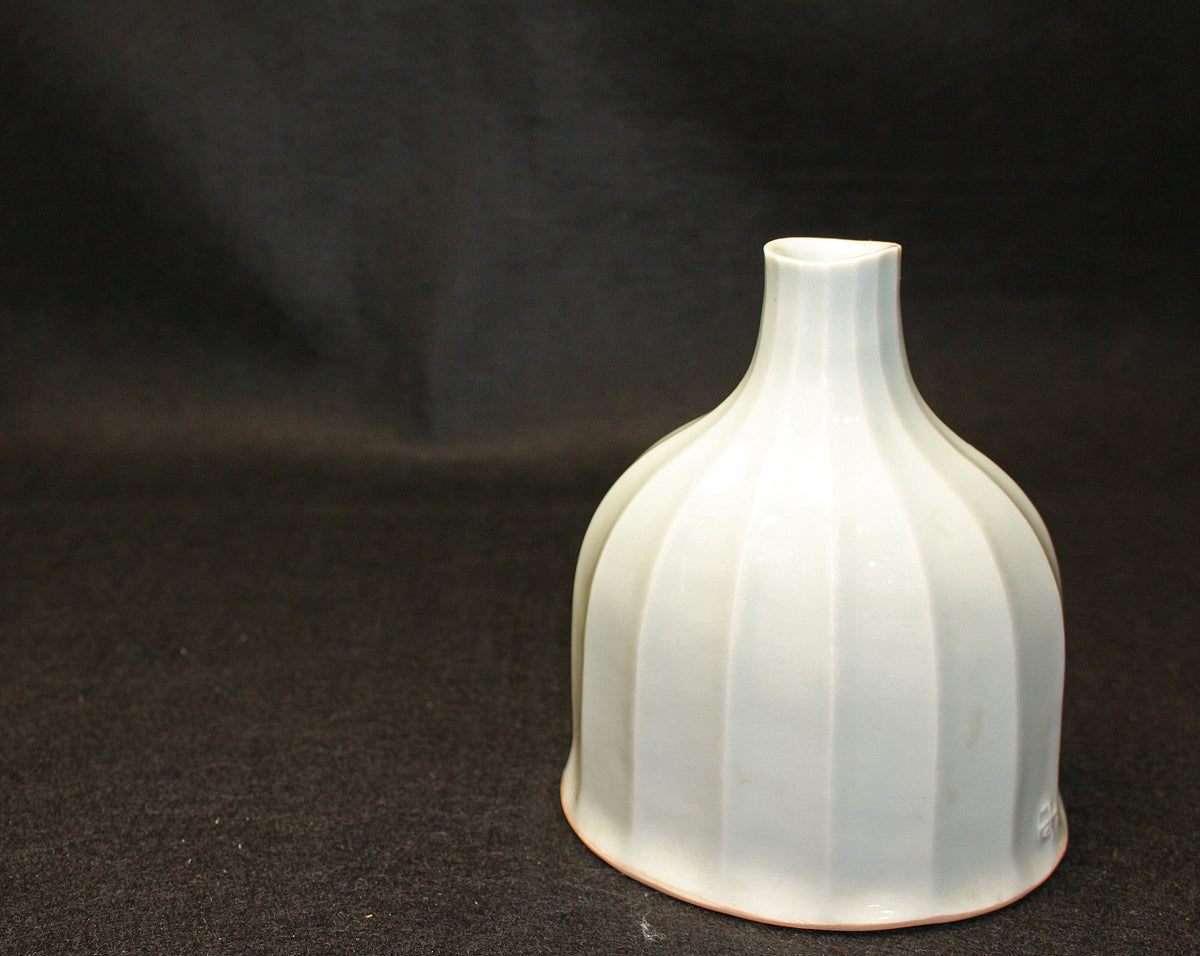


Diameter 10.4cm
Osamu Suzuki (November 15, 1926 - April 9, 2001) was a Japanese ceramic artist. He was highly praised for his poetic works, which feature abstract forms with motifs such as horses, birds, clouds, and the sun. He was a founding member of the Sodeisha company, which led the ceramics world in the postwar period. He is a professor emeritus at Kyoto City University of Arts.
Biography
He was born in 1926 in Gojozaka, Kyoto, as the third son of Suzuki Ugenji, a potter's wheel craftsman at the Eiraku Workshop, one of the Ten Craftsmen of the Senke family. He received early training in pottery from his father and graduated from the ceramics department of Kyoto Municipal Second Technical School (now Kyoto Municipal Fushimi Technical High School) in 1943.
After the war, in 1946 he joined the Young Potters Group, which was formed by young ceramic artists in Kyoto, led by Kiyoshi Nakajima. The group disbanded in 1948.
In the same year, together with Yagi Kazuo and Yamada Hikaru, he founded the avant-garde ceramics group Sodeisha, which aimed to create new forms of expression through ceramics. In 1954, he exhibited his work "Work," a closed vessel, at the first Asahi New Artists Exhibition. The emergence of ceramic works that were purely three-dimensional, without any intended use as vessels, was a groundbreaking event at the time.
Ceramic works that had no practical purpose, such as Yagi Kazuo's "Mr. Samsa's Walk," which was released in the same year, were called "object pottery" or "object ware."
However, Suzuki, who continued to pursue the creation of shapes using earth and fire, did not like his works to be called "objects," and began to use the terms "mud statues" and later "mud elephants" as the titles of his works. From the 1960s, he began to use two main techniques: Yakishime, which is applied with red engobe clay, and from 1971, he began to use blue-and-white porcelain, which has a fresh color.
The motifs are animals such as horses and birds, and natural phenomena such as wind and clouds, and these images are expressed in simple forms with a keen sense of form.
In 1982, he was ranked number one in the special feature "Top Ten Contemporary Ceramics" in the May issue of Geijutsu Shincho.
In 1998, on the occasion of the 50th anniversary of the founding of Sodeisha, the group decided to disband. He made significant proposals to avant-garde and contemporary ceramic art. He also made significant contributions as an educator, and taught the next generation of ceramic artists for many years as a professor in the ceramics departments of Osaka University of Arts and Kyoto City University of Arts. He passed away in 2001 at the age of 74.
The charm of Kagesei flower vase
Kagesei is a type of celadon porcelain characterized by its pale blue-green color. Suzuki Osamu uses this technique to create flower vases with his own unique interpretation and design.